
On Feb 12, 2019, at 16:16, Paul Beaufaitwrote:
Hi G...,
I was thinking of you earlier today, ....... your questions about pres. storage and retrieval sites, and identifying copyright material in extant presentations, might be a bit wide of the PSG's self-circumscribed remit. You still might [want to] inquire of JALT CALL SIG folk. Nevertheless, here's my two-cents['] worth.You're right about LinkedIn's appeal outside academic circles. I opted for SlideShare years ago, for ease of use as I recall–probably before integration with LinkedIn. However, I've been unable to find any spec's for free storage space today. Once you've uploaded to Slideshare (PDFs were recommended), content becomes virtually static, i.e., un-collabor-able. That is, unless you consider deep-diving (threaded) discussions [in comments] collaborative, which they may well become in certain other venues. I don't recall ever encountering or engaging in discussions like that on Slideshare.You didn't mention how many previous presentations you'd like to publicize. Since Dec. last year, however, I've been bouncing against the ceiling for free storage space on Google (all sorts of content counted together: Gmail, PDFs, photos, videos[,] ... – but not including Google-native Docs and Slides). That has been even though Google offers more space for free (https://www.cnbc.com/2018/10/01/google-hasnt-updated-gmail-drive-photos-storage-limit-in-5-years.html) than does MS OneDrive (https://onedrive.live.com/about/en-US/plans/).Regarding possibly copyright or otherwise licensed material in ready-made presentations, if it's images you're concerned about, Google (or other) image searches might turn up original sources and contextual authorship/licensing details. On blogs or other websites, I've found, those details usually appear on top pages and in page footers.YouTube once unceremoniously removed sound from a video I'd mixed with a tune that had come pre-packaged in the Mac video software that I'd used to produce it. Rather than attempt to argue (or litigate) the point against YouTube's done-deal, I simply replaced the tune with similar licks from a free music source. [A similar tactic may serve for image or text mash-ups.]Searches for text snippets you'd like to retrieve and acknowledge [the]... sources for might turn up periodicals (behind paywalls) or books (with sample pages visible on Amazon) as well. Covers and copyright pages of books (or previous citations with publication details) may be visible in or accessible via search results. Newsy articles may no longer be accessible at original URLS, if at all.Rediscovering exact page numbers for reference citations can be time-consuming if not troublesome. Requesting full texts of periodical articles from authors (via Academia or ResearchGate) or sending inquiries to journal editors are options. Both such sources may be keen on planned or projected citations.The best advice I can offer is forward-looking; collect all the details you think you may need–and more, when you first encounter suitable source material.If you do find primers covering those sorts of intellectual property rights re-discovery [emphasis added], please point them out to me! I'll be happy to add them to the PSG's Diigo Group bookmarks.Warm regards,PB
Tuesday, February 12, 2019
Where to put presentations and how to find info. about sources


Thursday, November 15, 2018
10 Ways To Instantly Make Your Blog Better! (Morris, 2018.11.12)
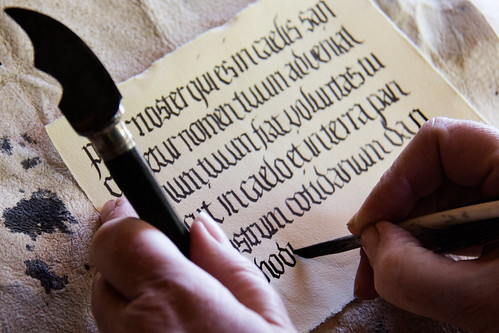 |
| Medieval Writing by Hans Splinter, 2013.06.02 Attribution-NoDerivs 2.0 Generic (CC BY-ND 2.0) |
Edublogger Kathleen Morris presented:
10 Ways To Instantly Make Your Blog Better! Want to build a more active and engaged audience for your blog? Here are 10 simple tips that you can start implementing today to make your blog instantly better!
Saturday, December 17, 2016
"Get tough, or die!"
Let me try to keep this story about advice I've received relatively short, yet informative. Though at first you may consider the advice valid only for participants in a particular event in Montana decades ago, in the end I hope you may find ways to generalize (adopt or adapt) it to your own circumstances. Here goes.
In high school, I competed in gymnastics. The coach of a cross-town rival team and I became friends after I had entered college, and beg[u]n judging local gymnastics meets.
In the off-season, the cross-town high school coach and I also became rivals in canoe races. In one race, actually a three-legged team-relay event, in which a grade school friend of mine had run, I'd cycled, and the two of us paddled together, my old friend and I finished fourth.
Though our running and cycling times weren't stellar, we'd been white-water canoeing together for years (since high school). So we passed a number of other teams on the river, including slow rafters, and were about to overtake another when the river narrowed.
As we passed just astern of a raft running the rapids ahead of us, an inner-tube it was towing on a tail line dragged under our canoe, and dumped us immediately. We lost time swimming the canoe to shore, emptying the water from it, and resuming the race.
At the end of the third leg of the race, my old friend and I finished fourth. My rival and his team had finished first or second. In the parking lot, at the end of the race, was where I got the advice.
My rival and his partner had loaded their low-cut racing canoe on his car rack. It was easy to distinguish from ours–a high-gunneled recreational model. The advice was on a bumper sticker on his car.
As the race committee began awarding prizes, it became clear that the third-place team hadn't waited around for awards. So my partner and I received the third prize. Though I don't remember what that prize was, I do remember the message on my rival's rear bumper.
It read, "Get tough, or die!"
[356 words]
Originally published on pab's potpourri, 2016.12.17, https://goo.gl/gDoXIj
Republished with permission of the author (pab)
Friday, May 22, 2015
We No Speak Americano - Understanding International Students' Writing
In this video by Wibergh and Hawthorne (2010), grammatically competent international students explain challenges they'd faced in academic writing in the U.S.
Reference
Wibergh, Felix (Producer), & Hawthorne, Nicholas (Director). (2010). We no speak americano: Understanding international students' writing [YouTube video]. U.S.: Nick Hawthorne's Channel. Retrieved from https://youtu.be/V7pYB6W049I
[48 words]
Tuesday, March 10, 2015
Writers, hasten slowly!
The poetry in the snapshot[s] below represent... sage advice from Nicolas Boileau to writers that derived from an ancient Greek adage by way of Latin, "festina lente" (Wikipedia, Festina lente), meaning hasten slowly.
 |
| "Hasten slowly..." (Boileau, 1674, & Beaufait, 2015), ver. 1 |
%5D%2BScreenshot%2B2015-03-11%2B10.40.44.png) |
| "Hasten slowly..." (Boileau, 1674, & Beaufait, 2015), ver. 2 |
The snapshot[s] above comes from a presentation in preparation by Edwards, Beaufait, and Lucovich ([n.p.], [n.d.], except as otherwise noted some rights reserved). The French text comes from the Wikipedia article (Festina lente, History, ¶5, similar rights reserved).
[147 words]
Subscribe to:
Posts (Atom)
