Showing posts with label quotations. Show all posts

Thursday, November 15, 2018

10 Ways To Instantly Make Your Blog Better! (Morris, 2018.11.12)

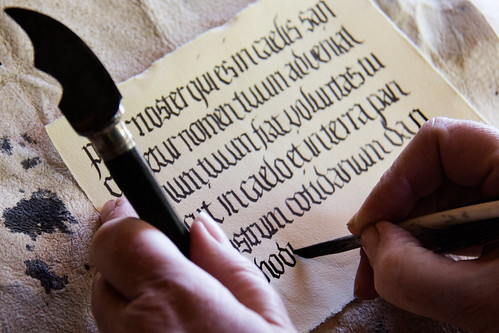
medieval writing
Medieval Writing by Hans Splinter, 2013.06.02
Attribution-NoDerivs 2.0 Generic
(CC BY-ND 2.0)

Edublogger Kathleen Morris presented:
10 Ways To Instantly Make Your Blog Better! Want to build a more active and engaged audience for your blog? Here are 10 simple tips that you can start implementing today to make your blog instantly better!

Saturday, December 17, 2016

"Get tough, or die!"

Let me try to keep this story about advice I've received relatively short, yet informative. Though at first you may consider the advice valid only for participants in a particular event in Montana decades ago, in the end I hope you may find ways to generalize (adopt or adapt) it to your own circumstances. Here goes.

In high school, I competed in gymnastics. The coach of a cross-town rival team and I became friends after I had entered college, and beg[u]n judging local gymnastics meets. 

In the off-season, the cross-town high school coach and I also became rivals in canoe races. In one race, actually a three-legged team-relay event, in which a grade school friend of mine had run, I'd cycled, and the two of us paddled together, my old friend and I finished fourth. 

Though our running and cycling times weren't stellar, we'd been white-water canoeing together for years (since high school). So we passed a number of other teams on the river, including slow rafters, and were about to overtake another when the river narrowed.

As we passed just astern of a raft running the rapids ahead of us, an inner-tube it was towing on a tail line dragged under our canoe, and dumped us immediately. We lost time swimming the canoe to shore, emptying the water from it, and resuming the race.

At the end of the third leg of the race, my old friend and I finished fourth. My rival and his team had finished first or second. In the parking lot, at the end of the race, was where I got the advice. 

My rival and his partner had loaded their low-cut racing canoe on his car rack. It was easy to distinguish from ours–a high-gunneled recreational model. The advice was on a bumper sticker on his car.

As the race committee began awarding prizes, it became clear that the third-place team hadn't waited around for awards. So my partner and I received the third prize. Though I don't remember what that prize was, I do remember the message on my rival's rear bumper.

It read, "Get tough, or die!"

[356 words]

Originally published on pab's potpourri, 2016.12.17, https://goo.gl/gDoXIj

Republished with permission of the author (pab)

Tuesday, March 10, 2015

Writers, hasten slowly!


The poetry in the snapshot[s] below represent... sage advice from Nicolas Boileau to writers that derived from an ancient Greek adage by way of Latin, "festina lente" (Wikipedia, Festina lente), meaning hasten slowly.

"Hasten slowly..." (Boileau, 1674, & Beaufait, 2015), ver. 1
"Hasten slowly..." (Boileau, 1674, & Beaufait, 2015), ver. 2

The snapshot[s] above comes from a presentation in preparation by Edwards, Beaufait, and Lucovich ([n.p.], [n.d.], except as otherwise noted some rights reserved). The French text comes from the Wikipedia article (Festina lente, History, ¶5, similar rights reserved).

[147 words]

Friday, November 7, 2014

Grammar Resources - University of Chicago Writing Program

The Grammar Resources page on the University of Chicago Writing Program website introduces students to "grammar and writing resources from around the web" (¶1). In addition to main sections covering various grammar, usage and style guides, there are sections explaining and pointing out resources for scientific and technical writing as well as for non-native speakers of English (see the sidebar on the site for details).

I'm so impressed with that webpage that I've bookmarked it already for the WinK Core: Weblogging in Kumamoto group on Diigo, and will add it to the Course Links list in the Writing Studio Blog sidebar right away.

Reference


The University of Chicago Writing Program. (n.d.). Grammar resources [webpage]. Retrieved from http://writing-program.uchicago.edu/resources/grammar.htm

[116 words]
via Blog this

Tuesday, September 9, 2014

Don't Study Hard; Study Smart!

Tough Guy
Photo by pabeaufait
February 24, 2008, © All rights reserved
Used with permission
"Students need to understand that learning happens not only during reading and studying, but in all sorts of ways, so that they can examine their own habits to know which ones may be helping or not, and [then] make adjustments" (Chen, 2014, Experimenting with Learning Tactics, ¶4).
In a KQED Mind/Shift post, Ingfei Chen introduced a book written by a former colleague and science reporter, Benedict Carey (2014), entitled How We Learn: The Surprising Truth .... Then Chen went on to highlight and give examples of three key take-aways from the book that she['d] gleaned from an interview with the author.

The post included some wonderful tips for self-aware and self-directed learners. Moreover, the voice recording that accompanied the article was of the highest quality imaginable ("Press Play to Listen ..."). Kudos to the unnamed voice artist who made the recording!

References

Carey, Benedict. (2014). How We Learn: The Surprising Truth about When, Where, and Why It Happens. New York, NY: Random House.

Chen, Ingfei. (2014, August 25). How does the brain learn best? Smart studying strategies [web log post]. Retrieved from http://blogs.kqed.org/mindshift/2014/08/how-does-the-brain-learn-best-smart-studying-strategies/

[182 words]

Wednesday, June 11, 2014

Springboard for Reflections and Predictions

In a six-minute TED Talk, The Psychology of Your Future Self (March 2014), Dan Gilbert, a research psychologist, suggested:
Most of us can remember who we were 10 years ago, but we find it hard to imagine who we're going to be ... [10 years from now]. Only when we look backwards do we realize how much change happens in a decade" (Interactive Transcript, ¶¶ 7-8, via Blog this).


As a step towards the next essay assignment, language learning stories, please watch that TED Talk, keeping your own language skills in mind. The next step will be to create a free-writing post in which you:
  1. Describe ... your language skills ten years ago,
  2. Describe your language skills at present, and
  3. Predict your language skills ten years from now.
[129 words]

Thursday, June 5, 2014

Free Online Game for Food Donations and Language Learning

Online game to end hunger 

Correct answers for Free Rice quiz items generate food donations paid for by sponsors, whose banners appear on the web page. The level of difficulty automatically adjusts up for correct and down for incorrect answers.

Though on one occasion an inappropriate banner appeared, the non-profit site owners had written, "We are quick and careful to remove inappropriate content, if it is reported to us via email at wfp.freerice@wfp.org with 'Report inappropriate content' ... in the subject line" (http://freerice.com/about/faq). So I reported that inappropriate banner.

There are English, French, Italian, and Spanish versions of the game on the same site, with more quiz categories for English than for the other languages. There also is a Korean version on a separate site:


Registration is separate for the two sites, but not necessary to play; it will enable you to track your contributions on one site or the other.

Reference


World Food Programme. (2014). Free Rice 2.0 [online game]. Retrieved
          June 5, 2014, from http://freerice.com

[165 words]

Monday, May 19, 2014

Dance Mat Typing (BBC, 2005)

Though the BBC developed the Dance Mat Typing site for school-aged children, seven to 11 years old, it also can help older students unfamiliar with touch typing get started (or restarted) typing quickly using all ten digits–fingers and thumbs on both hands. Amusing animated animal characters introduce keyboarding techniques and practice activities in a step-by-step fashion through four levels and 12 stages. Practice activities begin with ten keys in the home row (A-G and H-;), and work up to punctuation and capitalisation (BBC, 2005, About this site). The key to learning to type quickly and well from practice on site is to listen carefully to the instructions, paying special attention to what you see on screen rather than looking at your fingers or the keyboard. 

The animated characters speak (or mimic) different varieties of English, which may challenge learners of English as an additional language. Yet colourful screens show progress through each stage, and there are audio and visual cues to give feedback on mistyping during practice activities. Moreover, there is plenty of review practice–Warm Ups for every new stage, and the site offers printable certificates at the end of each level.


Working your way through each of the stages and levels, perhaps more than once, should make it much easier to complete both typing homework and writing assignments. As the BBC explained, "touch typing is the fastest way to write" (BBC, 2005, About this site, Why learn to touch type? ¶1).


Reference


BBC. (2005). Dance mat typing [website]. Retrieved from http://www.bbc.co.uk/schools/typing/


[255 words]

Thursday, April 17, 2014

BR 1-03: Hairy Maclary (Dodd, 1983)

Another favorite story with animals!

"'EEEEEOWWWFFTZ!' said Scarface Claw" (n.p.).

Hairy Maclary is an animal adventure story from New Zealand (NZ). It was a gift from a friend from . . . , you guessed it–NZ! It's a great story for pronunciation practice because of all of the rhymes. My favorite line from the book, the quotation above (no page numbers), is a bit of a challenge to pronounce. Can you say that big word, and make it sound like a . . .  (a four-footed animal)?

Reference

Dodd, Lynley. (1983). Harry Maclary from Donaldson's Dairy. Wellington, NZ: Mallinson Rendel Publishers Ltd.

[106 words]

Wednesday, April 16, 2014

BR 1-02: The Cross-with-Us Rhinoceros (Bush & Geraghty, 1988)

Photo of book cover, 2014.04.17

"Poor Tilly was so scared she couldn't speak" (Bush & Geraghty, 1988, n.p.*).

This is a children's book that I've read again and again. It is a great story about four children who went out together and had an adventure. Like the last book I reviewed, BR 1-01: Dear Zoo (2014.04.16), this one features animals. The ending was surprising, but I'm not going to tell you what happened. You'll have to read it for yourself.

Reference

Bush, John, & Geraghty, Paul. (1988). The Cross-with-Us Rhinoceros. London, England: Hutchinson Children's Books.

____________________
* This story doesn't have page numbers. If it did, I'd use "p. #" instead of "n.p." (no page number).

[117 words]

BR 1-01: Dear Zoo (Campbell, 1982)

I wrote to the zoo to send me a pet.... So they sent me a .... He was too grumpy! I sent him back. (Campbell, 1982, n.p.*)
Dear Zoo is a children's book. It is short and easy to read. It tells a story about animals coming from the zoo. There are little windows to open to see surprising things. If you like zoo animals, or easy books to read, I recommend this story.

Reference

Campbell, Rod. (1982). Dear Zoo. London, England: Campbell Books.

____________________
* This story doesn't have page numbers. If it did, I'd use "p. #" instead of "n.p." (no page number).


[106 words]

Tuesday, March 11, 2014

VocabKitchen: Awesome Vocab. Profilers!

 http://vocabkitchen.com/Default.aspx
http://vocabkitchen.com/Default.aspx
VocabKitchen's Academic Word List (AWL) Vocabulary Profiler (beta version) is already awesome! It quickly highlighted, listed, and sorted on- and off-list vocabulary in sample texts. It also was "dictionary enabled," which means you can get Longman Dictionary of Contemporary English Online definitions of almost any words by double-clicking on them (not a name like Tanaka). Though the percentages of on- and off-list words for the first sample I tried didn't add up (7% + 101%, respectively), text and highlight colours were easy to read on the white background.

VocabKitchen's General Service List (GSL) Vocabulary Profiler (beta version) performed similarly well on the same sample. Highlighting, listing and sorting was speedy, but again the percentages didn't add up (see below). It's still a quick, cool, easy-to-use tool. However, VocabKitchen's choice of tint for highlighting words in in the GSL 2nd 1K (RGB: 48, 152, 204) offered slightly less background-to-text contrast than had the AWL Vocabulary Profiler's on-list colour (especially when used on a grey heading bar), and the location of the sort button in the GSL-beta profiler differed for off-list words.


VocabKitchen's Common European Framework of Reference for Languages (CEFR) Vocabulary Profiler was available in both a beta and a regular version. The main differences seemed to be that 1) the CEFR-beta version was "dictionary enabled" like the AWL-beta profiler, and 2) the CEFR-beta version also provided an Export to Word function. Nevertheless, background-to-text contrast, at least for B1 level words and corresponding headings (RGB: 249, 154, 0), seemed a bit problematic.


On the CEFR-beta display, VocabKitchen avoided the low-contrast problem on grey header bars by using a shade close to black (RGB: 34, 34, 34). Something closer to black (0, 0, 0) might be even better!


VocabKitchen (also in beta), please keep up the good work. I'm looking forward to trying out the Social Reader Tool. In the mean time, I'll strive to cut down on off-list words–at least on this blog!

[328 words]

Tuesday, March 4, 2014

PaperRater Grammar and Spelling Check

"PaperRater.com is a free resource, developed and maintained by linguistics professionals and graduate students. PaperRater.com is used by schools and universities in over 46 countries to help students improve their writing" (About PaperRater, ¶1, 2014.03.04).
Screen snapshot of graphic on the PaperRater site
This post frames a comment that I posted today on the Digital Mobile Language Learning blog (Writing Tools for the Self-directed Learner Part 2, 2014.01.19), after trying out PaperRater, which provides, among other free services:
  • Spelling and grammar checks,
  • Style and word choice analyses, and
  • Readability statistics (PaperRater: Features).
After trying a Google+ post that was too short to ... [get] feedback on many of the categories, I gave Paper Rater (PR) another spin on a working paper I ... [had written] a while back. The whole paper turned out to be too long for free assessment, so I cut the sample back to the end of the first section: 719 words per PR's count, 777 per Microsoft® Word 2008 for Mac. 
PR results, as Dan [Ferreira] suggested they would be, were quite interesting: 
+/- The spell check flagged one word apparently broken in the PDF from which I'd copied the sample, but also returned a false positive on the word conflate.  
+ Grammatical analysis revealed no errors. 
+ The numerical score for inappropriate word choices was, I guess, low (0.998). 
+/- The feedback on style in the web display focused mostly on sentence length (the longest: 53 words), but mistakenly indicated that more than half of the sentences were passive. I checked by hand, but found only one passive clause–in a quotation. 
-/+ Though the feedback on style in the PDF output was different, focusing on transition words, the PDF included general tips for using such words. 
+/- The vocabulary score seemed high (96), yet the feedback included only a subset (9 of 20) sophisticated words counted. Paper Rater did not mark such words in the sample. 
The numeric grade from the auto-grader bore a note to the effect that it was "based on [a] college grading scale," which was followed by a stronger one indicating that PR "does NOT examine the meaning of your words, how your ideas are structured, or how well your arguments are supported" [(Auto Grader, NOTE, ¶1)].
All in all, PR looks like it's worth asking students to try, as long as they can grasp its limitations.
I'm looking forward to trying it out with students soon.

[413 words]

Wednesday, January 29, 2014

KGUW_3-4_13-14: Reflections from §1C


Insights for students
taking Writing III and IV
next year (2014-15)


Students who have taken part in Writing IV, section 1C, are to post reflections based on their experience this year in comments on this post, for the benefit of their successors next year. The presentation below outlines the short essay writing task calling for current students to prepare, compose, and post their reflections in comments on this post.


[69 words]

KGUW_3-4_13-14: Reflections from §1A


Insights for students
taking Writing III and IV
next year (2014-15)


Students who have taken part in Writing IV, section 1A, are to post reflections based on their experience this year in comments on this post, for the benefit of their successors next year. The presentation below outlines the short essay writing task calling for current students to prepare, compose, and post their reflections in comments on this post.


[69 words]

Wednesday, January 15, 2014

"Five secrets to revising that can boost your grades" (Stafford, 2014)

In a Guardian Students series article, Five secrets to revising that can boost your grades (Education, Advice for students, 8 January 2014), Tom Stafford provided "evidence-based tips" for students who want to learn effectively (¶7). Among other points, he asserted, "Merely memorising the material is not enough" (3. Practice the thing you'll be tested on, ¶1).
[59 words]

Thursday, May 9, 2013

Tip Top Tip from Mike Lambert


Mike Lambert, the author of A Beginner’s Guide to Doing Your Education Research Project (Lambert, 2012), has published ten tips in a paper on the Academia.edu site (Lambert, 2013). One of my favorites is number nine.

Tip 9: Use paragraphs

A paragraph is a section of text, usually dealing with a single theme and [usually] indicated by a line space above and below . . . . The use of paragraphs is an important way of structuring writing and making ideas understandable for your reader[s]. Here are some basic rules for using paragraphs in academic writing:

  • A paragraph always has more than one sentence[;]
  • A paragraph is never more than one page long[; and]
  • The first or last sentence of a paragraph is often a summary of the paragraph as a whole.

. . .

Lambert concludes that section of his paper with a brilliant suggestion for beginning writers: "Look at academic books and research articles to see how others use paragraphs to make the structure of their writing clear."

References


Lambert, Mike. (2012). A Beginner’s Guide to Doing Your Education Research Project. London, England: Sage Publications.

Lambert, Mike. (2013, April [n.d.]). Top Tips for Writing Up Your Education Research Project. Retrieved from http://www.academia.edu/3357616/Top_Tips_for_Writing_Up_Your_Education_Research_Project

[205 words]

Friday, March 1, 2013

Examples of Quotations and Ellipses


In this post, there are examples of quotations from an article on a website, and from a report published online in portable document format (PDF). Some longer examples include ellipses, or removals of words. There are short references in parentheses in the body of this post, and complete references at the end to point out the sources of the quotations.


Quotation within a quotation

In the passage below that I've quoted from the article on a website, Clark (2012) had quoted parts of the report (EF English First [EF], 2012). I've highlighted in yellow the parts of the report that Clark had quoted, both in my quotation from the website (below) and in another quotation from the original report (farther below).

". . . English will maintain and grow its dominance, moving from 'a marker of the elite' in years past to 'a basic skill needed for the entire workforce, in the same way that literacy has been transformed in the last two centuries from an elite privilege into a basic requirement for informed citizenship'" (Clark, 2012, ¶1, after EF, 2012).

Please note that Clark had combined phrases from two sentences in the original report into a single sentence structure of her own. The ellipsis, three spaced periods (". . . "), at the beginning of my quotation from the website (above) shows where I've shortened Clark's sentence.

However, I have replaced double quotation marks that were in the passage from Clark's article above with single quotations to show the beginnings and ends of Clark's quotations within my quotation (above). Replacing double quotation marks with single quotation marks indicates quotations within quotations.


  • Double quotation marks show the beginnings and ends of my quotations from the webiste (above) and from the report itself (below).
  • Single quotation marks within the double quotation marks above show the beginnings and ends of the parts of the original report that Clark had quoted.


Long quotation of the original

In the following quotation of the original passage from the EF report, and in the quotations with ellipses below that, please note that there are only double quotation marks.


"Today English proficiency can hardly be thought of as an economic advantage at all. It is certainly no longer a marker of the elite. Instead it is increasingly becoming a basic skill needed for the entire workforce, in the same way that literacy has been transformed in the last two centuries from an elite privilege into a basic requirement for informed citizenship" (EF, 2012, p. 12).


Original with ellipses


In both of the shortened quotations below, please note that ellipsis still shows where I've cut words out, and that I've shortened the quotations in ways that preserve grammatical units. Please also note that square brackets show where I've added words for clarification.


"Today English proficiency . . . is certainly no longer a marker of the elite. Instead it is increasingly becoming a basic skill needed for the entire workforce, . . . [and] a basic requirement for informed citizenship" (EF, 2012, p. 12).


"Today English proficiency . . . is increasingly becoming a basic skill needed for the entire workforce, . . . [and] a basic requirement for informed citizenship" (EF, 2012, p. 12).


Bits of the original recontextualized

In a message for prospective students that I prepared yesterday, I shared EF's assertions that English is not only "a basic skill needed for the entire workforce," but also "a basic requirement for informed citizenship" (EF, 2012, p. 12).


References


Clark, Dorie. (2012). English - The Language of Global Business? Retrieved February 28, 2012, from http://www.forbes.com/sites/dorieclark/2012/10/26/english-the-language-of-global-business/


EF Education First [EF]. (2012). EF English Proficiency Index 2012 [PDF]. [n.p.]: EF Education First. Retrieved February 28, 2013, from http://www.ef.com/__/~/media/efcom/epi/2012/full_reports/ef-epi-2012-report-master-lr-2


[625 words]


Wednesday, January 30, 2013

KGUW_3-4_12-13_1C: Advice from §1C

Advice for students
taking Writing III and IV
next year (2013-14)

In comments on this post, students who have taken part in Writing IV, section 1C, are to provide advice based on their experience this year, for the benefit of their successors next year. The presentation below outlines the short essay writing task calling for the former to prepare, compose, and post their advice for the latter.


[69 words]
Related Posts Plugin for WordPress, Blogger...