Wednesday, March 13, 2019

Purdue OWL sports citation generator

What a pleasant surprise it was to find that the Purdue University Online Writing Laboratory (OWL) now displays a user-friendly citation generator embedded near the top of APA Style pages from the APA Overview and Workshop page downstream.

Purdue OWL navigation sidebar, 2019.03.13


Image source: APA Formatting and Style Guide–General Format page

The citation generator produced the following website citation for that particular page:

Purdue Writing Lab. (n.d.). General Format // Purdue Writing Lab. Retrieved from https://owl.purdue.edu/owl/research_and_citation/apa_style/apa_formatting_and_style_guide/general_format.html

[101 words]

Tuesday, February 12, 2019

Where to put presentations and how to find info. about sources


On Feb 12, 2019, at 16:16, Paul Beaufait wrote:

Hi G...,

I was thinking of you earlier today, ....

... your questions about pres. storage and retrieval sites, and identifying copyright material in extant presentations, might be a bit wide of the PSG's self-circumscribed remit. You still might [want to] inquire of JALT CALL SIG folk. Nevertheless, here's my two-cents['] worth. 

You're right about LinkedIn's appeal outside academic circles. I opted for SlideShare years ago, for ease of use as I recall–probably before integration with LinkedIn. However, I've been unable to find any spec's for free storage space today. Once you've uploaded to Slideshare (PDFs were recommended), content becomes virtually static, i.e., un-collabor-able. That is, unless you consider deep-diving (threaded) discussions [in comments] collaborative, which they may well become in certain other venues. I don't recall ever encountering or engaging in discussions like that on Slideshare.

You didn't mention how many previous presentations you'd like to publicize. Since Dec. last year, however, I've been bouncing against the ceiling for free storage space on Google (all sorts of content counted together: Gmail, PDFs, photos, videos[,] ... – but not including Google-native Docs and Slides). That has been even though Google offers more space for free (https://www.cnbc.com/2018/10/01/google-hasnt-updated-gmail-drive-photos-storage-limit-in-5-years.html) than does MS OneDrive (https://onedrive.live.com/about/en-US/plans/).

Regarding possibly copyright or otherwise licensed material in ready-made presentations, if it's images you're concerned about, Google (or other) image searches might turn up original sources and contextual authorship/licensing details. On blogs or other websites, I've found, those details usually appear on top pages and in page footers. 

YouTube once unceremoniously removed sound from a video I'd mixed with a tune that had come pre-packaged in the Mac video software that I'd used to produce it. Rather than attempt to argue (or litigate) the point against YouTube's done-deal, I simply replaced the tune with similar licks from a free music source. [A similar tactic may serve for image or text mash-ups.]

Searches for text snippets you'd like to retrieve and acknowledge [the]... sources for might turn up periodicals (behind paywalls) or books (with sample pages visible on Amazon) as well. Covers and copyright pages of books (or previous citations with publication details) may be visible in or accessible via search results. Newsy articles may no longer be accessible at original URLS, if at all.

Rediscovering exact page numbers for reference citations can be time-consuming if not troublesome. Requesting full texts of periodical articles from authors (via Academia or ResearchGate) or sending inquiries to journal editors are options. Both such sources may be keen on planned or projected citations.

The best advice I can offer is forward-looking; collect all the details you think you may need–and more, when you first encounter suitable source material. 

If you do find primers covering those sorts of intellectual property rights re-discovery [emphasis added], please point them out to me! I'll be happy to add them to the PSG's Diigo Group bookmarks.

Warm regards,

PB


Paul A. Beaufait
Owner/Curator/Admin.
https://goo.gl/wYW1ks ([a] Google site)


Thursday, November 15, 2018

10 Ways To Instantly Make Your Blog Better! (Morris, 2018.11.12)

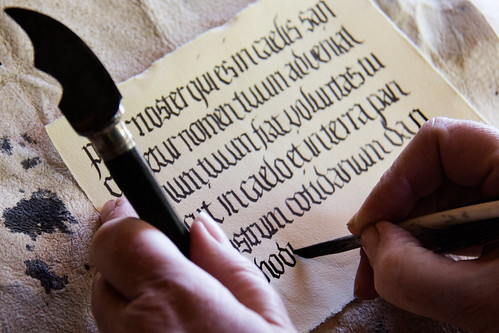
medieval writing
Medieval Writing by Hans Splinter, 2013.06.02
Attribution-NoDerivs 2.0 Generic
(CC BY-ND 2.0)

Edublogger Kathleen Morris presented:
10 Ways To Instantly Make Your Blog Better! Want to build a more active and engaged audience for your blog? Here are 10 simple tips that you can start implementing today to make your blog instantly better!

Saturday, December 17, 2016

"Get tough, or die!"

Let me try to keep this story about advice I've received relatively short, yet informative. Though at first you may consider the advice valid only for participants in a particular event in Montana decades ago, in the end I hope you may find ways to generalize (adopt or adapt) it to your own circumstances. Here goes.

In high school, I competed in gymnastics. The coach of a cross-town rival team and I became friends after I had entered college, and beg[u]n judging local gymnastics meets. 

In the off-season, the cross-town high school coach and I also became rivals in canoe races. In one race, actually a three-legged team-relay event, in which a grade school friend of mine had run, I'd cycled, and the two of us paddled together, my old friend and I finished fourth. 

Though our running and cycling times weren't stellar, we'd been white-water canoeing together for years (since high school). So we passed a number of other teams on the river, including slow rafters, and were about to overtake another when the river narrowed.

As we passed just astern of a raft running the rapids ahead of us, an inner-tube it was towing on a tail line dragged under our canoe, and dumped us immediately. We lost time swimming the canoe to shore, emptying the water from it, and resuming the race.

At the end of the third leg of the race, my old friend and I finished fourth. My rival and his team had finished first or second. In the parking lot, at the end of the race, was where I got the advice. 

My rival and his partner had loaded their low-cut racing canoe on his car rack. It was easy to distinguish from ours–a high-gunneled recreational model. The advice was on a bumper sticker on his car.

As the race committee began awarding prizes, it became clear that the third-place team hadn't waited around for awards. So my partner and I received the third prize. Though I don't remember what that prize was, I do remember the message on my rival's rear bumper.

It read, "Get tough, or die!"

[356 words]

Originally published on pab's potpourri, 2016.12.17https://goo.gl/gDoXIj

Republished with permission of the author (pab)

Friday, May 22, 2015

We No Speak Americano - Understanding International Students' Writing

In this video by Wibergh and Hawthorne (2010), grammatically competent international students explain challenges they'd faced in academic writing in the U.S. 


Reference

Wibergh, Felix (Producer), & Hawthorne, Nicholas (Director). (2010). We no speak americano: Understanding international students' writing [YouTube video]. U.S.: Nick Hawthorne's Channel. Retrieved from https://youtu.be/V7pYB6W049I

[48 words]

Tuesday, March 10, 2015

Writers, hasten slowly!


The poetry in the snapshot[s] below represent... sage advice from Nicolas Boileau to writers that derived from an ancient Greek adage by way of Latin, "festina lente" (Wikipedia, Festina lente), meaning hasten slowly.

"Hasten slowly..." (Boileau, 1674, & Beaufait, 2015), ver. 1
"Hasten slowly..." (Boileau, 1674, & Beaufait, 2015), ver. 2

The snapshot[s] above comes from a presentation in preparation by Edwards, Beaufait, and Lucovich ([n.p.], [n.d.], except as otherwise noted some rights reserved). The French text comes from the Wikipedia article (Festina lente, History, ¶5, similar rights reserved).

[147 words]

Friday, February 13, 2015

WSBlog Bedtime + Best Biblio's and PFs

Eight years I plugged away at chronicling, filtering, modelling, showcasing, recycling, reflecting, and reviewing in posts for students on the Writing Studio Blog (WSBlog). During that time, I learned a lot about blogging with students, and there have been several satisfying advances in Blogger blog affordances as well, for example the advent of pages, and the threading of comments on posts.

Blogger renamed widgets gadgets, and baked many new ones in, which made them easy for casual bloggers such as English-as-an-additional-language learners to use. The link roll on the WSBlog has grown to almost a page in length, and the label cloud, to almost a page and a half (actual size). Embeddable external-source gadgetry like Cluster Maps and Flag Counter indicate[s] that the WSBlog had over 7,000 (perhaps not unique) visitors in the four years up till November 2014, and that there have been well over 18,000 page views since August 2010.

Though I'm relatively certain that those aren't the largest numbers in the blogosphere, they're large enough to reflect on with a certain degree of satisfaction. Regrettably, however, RSS services that colleagues and I had adopted to concatenate feeds of independent learner blog entries for inclusion in our teaching blogs went the way many free or inexpensive services do, and workarounds never quite made it back to the stage of single feeds to display posts from multiple blogs in now standard RSS gadgets–so much to do, and so little time to do it.

Before I put the WSBlog into suspended animation (from which it might snore itself awake from time to time), I'd like to do one more little bit of showcasing–this time not for students in successive cohorts, but rather for those in classes which finished meeting last month. They sat exams on January 28, 2015.

To wrap things up for now, I'd like to point out to class members and their near-peers a few of the best bibliographies–modified APA-style lists of books that individual students reviewed, and the most reflective portfolios (PFs) in pages that students added or linked to their blogs.
  • Students, please remember that if you aren't logged in to your university accounts, Google documents and spreadsheets stored on the university site will be invisible. 
  • Please also note that for the PFs themselves, the writing before, between and after the iframes was more important than the activities and progress represented within the iframes.
Without further adieu, ...

Best biblio's (book listings):

  1. Takahiro's
  2. Nana's, and
  3. Rina's (includes a good first go at a movie listing, too); and 

Best PFs:

  1. Misaki's
  2. Miri's and Nana's (tie), and
  3. Kazuyo's.
Many thanks to all!

[445 words]

Sunday, February 1, 2015

Thursday, January 8, 2015

More Practically Perfect Predecessors' Portfolios

As you are developing your own portfolios, I'd like to ask you to do the following. Please:
  1. View the slides in the presentation embedded below, 
  2. Follow the instructions on slide two and slide three, and 
  3. Review the portfolios that you find via the links on slide four. 
Then please return to this post, and add a comment explaining which of your predecessors's portfolios you think is the best from each section (§1A and §1C), and why you think so.

Thank you in advance for you cooperation.


__________
Note: This post reuses and revises text from a previous post (Practically Perfect Predecessors' Portfolios, 2013.07.13) with the original author's permission.

[110 words]

Wednesday, December 3, 2014

Collective Maps and [Rough] Outlines . . .

First off, I'd like to thank everyone who shared topic suggestions in class today to build into the maps and outlines in this post. I'd also like to point out that the two maps and corresponding outlines in this post cover some divergent, some similar, and some overlapping topics and sub-topics.

Neither the maps below nor the outlines farther below completely cover the topic for your next essays. Since the maps and outlines below cover only a few of the ideas upon which you may wish to focus in your essays about learning with computers, I want to encourage all of you to feel free to draw ideas for your draft essays (2-03a) from both sets of shared ideas (§1A & §1C). You also are welcome to combine those ideas with others from your individual outlines and essay prep. posts, as well as from previous posts on the Writing Studio Blog including outlines or about computers.

For convenience, I arranged the main ideas (in blue) in alphabetical order during and just after class. However, as you compose your draft essays, I hope you will find better ways to organize your main ideas than that. Moreover, some of the topics in green may be just as important as the main ideas in blue. So I expect you to demonstrate flexibility in composing important and related ideas into unified paragraphs that will enable readers to follow your thinking easily from one main point in your essays to the next.

§1A, 2014.12.03

§1C, 2014.12.03 

Outline from §1A

Learning with Computers
  • Applications
    • PowerPoint
    • Other
  • Challenges
    • keyboarding
  • Convenience
    • Google
      • Drive
      • Gmail
    • Search
      • Google
        • Images
      • Yahoo!
      • Other
    • Recording
      • Microphones
        • Built-in
        • Attached
    • Playback
      • CDs
      • DVDs
  • Economy
    • Paper-less materials
      • Homepages
      • Other
    • Other?
  • Importance
    • School
      • English
        • Keyboarding
          • Numeric keypad
          • Typing
        • Classes
          • Listening
            • Classwork
              • Pronunciation practice
              • Viewing
                • News programs
            • Homework
              • Pronunciation practice
          • Reading
            • Websites
              • News articles
              • Other?
          • Speaking
            • Classwork
            • Homework
              • EnglishCentral
                • speaking points
                • (pronunciation practice)
          • Writing
            • Book reviews
            • Comments
            • Extensive writing
              • Essays
              • Reports
      • Homepages
    • Society
      • Communication
        • Commentary
        • Other
      • Information
        • News
        • Publicity
          • Homepages
          • Other
      • Internationalization

Outline from §1C

Learning with Computers
  • Applications
    • Computer-based
      • Search function
      • Typing programs
    • Cloud-based (online)
      • Sharing
      • Typing practice
      • Language learning
        • PowerWords
        • EnglishCentral
  • Benefits
    • Ease of correction
      • written work
        • reports
    • Exposure to vocabulary
    • Increase in typing speed
  • Coursework
    • Listening Classes
      • Classwork
        • CDs
      • HW
    • Reading Classes
      • Classwork
        • Online texts
          • news articles
      • HW
        • PowerWords
        • Reports
    • Speaking Classes
      • Classwork
      • HW
        • EnglishCentral
          • speaking points
    • Writing Classes
      • HW
        • typing
        • blogging
          • reviewing
      • Classwork
        • Mapping
        • Outlining
        • Peer-reviewing
  • Disadvantages
    • Time loss
      • computer set-up
    • Dependencies
      •  
    • Diminished skills
      • calculating in your head
    • Physical strain
      • Eyes
      • Neck
      • Shoulders
  • Other activities
    • job-hunting
    • ???

If you have concerns or questions about those maps or outlines, or how to use them, please feel free to spell them out in comments on this post, or voice them in person during the next class meeting.

[586 words]

Tuesday, November 25, 2014

Do you know what day it is?

On the United Nations' calendar, it's the International Day for the Elimination of Violence against Women, and the beginning of the UN Secretary General's campaign for over two weeks of activism on related themes.

Image source: United Nations
End Violence Day

On the main page about the day, you'll find rationales for international activities and observations, alongs with facts and figures about violence against women and its consequences. There's more info. about the Secretary General's campaign here, including a poster on "school-related gender-based violence (SRGBV) in [the] Asia-Pacific" region:

Image source: United Nations
School-Related Gender-Based Violence
(SRGBV)

On the Orange Day page is a call for business, governmental, institutional and social action. Want to find out what you can do? Grab the toolkit (PDF) and get started!

[129 words]

Wednesday, November 19, 2014

Survey findings: Best comments on essays

Here is a snapshot of findings from the survey today about comments from classmates on your essays (2-02a).
Screenshot of digest, 2014.11.19, 18:50:27:
Click for a closer look.
Thank you for your cooperation!

[22 words]

Monday, November 17, 2014

How to learn a new language: 7 secrets from TED Translators

In a recent post on the TED Blog, Krystian Aparta digested numerous volunteer TED Talk translators' language learning strategies "into seven basic principles" (Aparta, 2014, ¶1). The first was realistic goal-setting, the seventh was not being intimidated by the possibility of making mistakes , and there were several other goodies in between.

Reference

Aparta, Krystian. (2014, November 4). How to learn a new language: 7 secrets from TED Translators [web blog post]. Retrieved from http://blog.ted.com/2014/11/04/how-to-learn-a-new-language-7-secrets-from-ted-translators/
'via Blog this'
[77 words]

Friday, November 7, 2014

Grammar Resources - University of Chicago Writing Program

The Grammar Resources page on the University of Chicago Writing Program website introduces students to "grammar and writing resources from around the web" (¶1). In addition to main sections covering various grammar, usage and style guides, there are sections explaining and pointing out resources for scientific and technical writing as well as for non-native speakers of English (see the sidebar on the site for details).

I'm so impressed with that webpage that I've bookmarked it already for the WinK Core: Weblogging in Kumamoto group on Diigo, and will add it to the Course Links list in the Writing Studio Blog sidebar right away.

Reference


The University of Chicago Writing Program. (n.d.). Grammar resources [webpage]. Retrieved from http://writing-program.uchicago.edu/resources/grammar.htm

[116 words]
via Blog this

Friday, September 19, 2014

Writing Better Blog Posts: What You NEED to Know - The Edublogger

Though a bit dated, Writing Better Blog Posts: What You NEED to Know by Sue Waters (April 18, 2011) is ... loaded with good advice. I found out about that post in a weekly email bulletin from Edublogs entitled The Edublogger Archives: The Best of the Best (September 19, 2014), so I'm not the only person who thinks that's [still] a great post.

As you begin blogging again for fall semester, or continue–if you kept blogging during the summer recess, I urge you to review Sue's advice with an eye out for ways to improve your own posts. Then please drop back by here and post comments about what works for you!

[114 words]

Tuesday, September 9, 2014

Don't Study Hard; Study Smart!

Tough Guy
Photo by pabeaufait
February 24, 2008, © All rights reserved
Used with permission
"Students need to understand that learning happens not only during reading and studying, but in all sorts of ways, so that they can examine their own habits to know which ones may be helping or not, and [then] make adjustments" (Chen, 2014, Experimenting with Learning Tactics, ¶4).
In a KQED Mind/Shift post, Ingfei Chen introduced a book written by a former colleague and science reporter, Benedict Carey (2014), entitled How We Learn: The Surprising Truth .... Then Chen went on to highlight and give examples of three key take-aways from the book that she['d] gleaned from an interview with the author.

The post included some wonderful tips for self-aware and self-directed learners. Moreover, the voice recording that accompanied the article was of the highest quality imaginable ("Press Play to Listen ..."). Kudos to the unnamed voice artist who made the recording!

References

Carey, Benedict. (2014). How We Learn: The Surprising Truth about When, Where, and Why It Happens. New York, NY: Random House.

Chen, Ingfei. (2014, August 25). How does the brain learn best? Smart studying strategies [web log post]. Retrieved from http://blogs.kqed.org/mindshift/2014/08/how-does-the-brain-learn-best-smart-studying-strategies/

[182 words]

Thursday, July 10, 2014

The Unsplash collection of photos for free

Unsplash features pre-screened, public domain (CC0 1.0 Universal licensure), high-resolution photos in a collection that apparently began in May 2013 (Unsplash archive).

The problem is that there currently aren't built-in provisions for searching the collection. That is, other than the [chronological] archives. On-site options include:
  • Manually scrolling and visually scanning the main page, 
  • Searching the main page for names of photographers you may know, or 
  • Scrolling and scanning the thumbnails in the annual or monthly archives. 
Fortunately, perhaps, a web developer, Arthur Weill, Director of Web and Cow, has been working on the problem. His Unsplash Search (beta, n.d.) is out in both English and French.

Searches may combine selections from a few dozen tags. For instance, a search for an image including a "tree" and resembling a "town" turned up the two photos here:

Boat on the river. Well, river only. — with Kabir Van Delić.
By Ermin ÄŒeliković

Luxor Egypt, in Days by the Nile
By Linh Nguyen
[166 words]

Wednesday, July 9, 2014

The end of semester draws nigh!

What you do in these last few weeks is extremely important, if you want to earn credit for Writing III this year. This post provides a count-down to help keep you on track for successful completion of coursework.


Today's class: Wed., July 9th

Today was the next-to-last regular class meeting for spring semester. Those of you who were absent should:

  • View the two most recent snapshots (class work and homework, 2014.07.09) in the white-board snapshots folder that your instructor has shared with you, and then
  • Ask classmates (§1C) or peers (§1A) who attended class today to help you to understand and do what you missed.


Make-up class: Next Wed., July 16th

Next Wed., from 9:00 to 10:30 a.m., is an early make-up class for students from §§ 1A and 1C who will be going abroad before the last regular class meeting (July 23rd, below). Those students will need to attend the make-up class next Wed. 

However, your instructor would like to invite the rest of you to come as well, to use the computer lab. space that he has reserved, so you can work together to catch up on and improve work on all assignments due before final exams. That is, the rest of you are welcome to attend the early make-up session, too, but only if you arrive by 9:00 a.m.


Last regular class meeting: Wed., July 23rd

The last regular class meetings this semester will be Wed., July 23rd, at the usual times. Everyone who is not going abroad on a university-sanctioned exchange program will need to attend. 


Last day of classes: Tues., July 29th

All course work except final blog posts, peer-to-peer comments, and Proto-Portfolio entries for July (below) will be due by midnight, July 29th, the last day of classes this semester. Course work due July 29th includes: 

  • Book reviews,
  • Corresponding bibliography entries, and 
  • Portfolio Elements updates and revisions.


Exam periods for Writing III, §§ 1A and 1C: Wed., July 30th

Semester final exams for students not going abroad on a university-sanctioned exchange program will be on Wed., July 30. Please note that exams periods are on a one-hour time schedule. You should plan to arrive 10-15 minutes before starting times, and have your work stations and browsers ready for use, because exams will begin immediately.


Proto-Portfolio (PPF) entries for July: Fri., Aug. 1st

All PPF entries for July will be due at the usual time: 5:00 p.m., the first of next month; Fri., Aug. 1st.* 


Please talk over this schedule of events with your classmates and peers. Then, if you have any concerns or questions about this count-down to the end of Writing III this semester, please spell them out in comments on this post at least 48 to 72 hours before particular events in the count-down. That lead-time will give your classmates, peers, and instructor an opportunity to share related concerns, questions, and understandings.

 ____________________
* Note: Original blog posts, book reviews, and peer-to-peer comments from Aug. 1st onward will count as fall semester coursework for Writing IV in §§ 1A and 1C.

[495 words]

Thursday, June 12, 2014

Language Skills: Collective Mind-Map of Topics from Free-Writing, §1A

The graphic in this post is to remind you of topics that you and your classmates shared from your free-writing posts on Wednesday, June 11. If you click on the graphic, you will be able to get a close look at the sub-topics on small branches of the mind-map. I've made two such posts: 
Please feel free to adopt topics, sub-topics, and organisational ideas from either of them to include in your next draft essays. 


[93 words]

Language Skills: Collective Mind-Map of Topics from Free-Writing, §1C

The graphic in this post is to remind you of topics that you and your classmates shared from your free-writing posts on Wednesday, June 11. If you click on the graphic, you will be able to get a close look at the sub-topics on small branches of the mind-map. I've made two such posts: 
Please feel free to adopt topics, sub-topics, and organisational ideas from either of them to include in your next draft essays. 


[93 words]
Related Posts Plugin for WordPress, Blogger...